

Health education
It's all a bit academic

Following our readers’ wishes, we are aiming to report more often on the latest knowledge on health impacts of air pollution. So, dear reader…
Unfortunately, for our tidy editorial brains, there is a bit of everything since we last reported about six weeks ago! The only clear theme is that air pollution exposure is bad for you (sorry to say…)
Here are some key recent studies and articles:
link to kidney disease, driving hospitalisation even from short bursts of high pollution exposure
potential contribution to depression and other aspects of mental health in an article drawing together studies on risks across the population as well as lab-based studies to understand the mechanisms
impact on menstrual cycle, in a study across 230 cities looking at smoke exposure
exposure in the womb linked to slower language and motor development, in a ground-breaking study from King’s College London
updated research on diabetes, noting that confounding factors are hard to account for an more research is needed
an overview of the health impact in Africa, where air pollution led to 1.1 million deaths on the continent in 2019
and for a more human-centred story, how moving out of a polluted city lessened asthma symptoms.
Sometimes though, air pollution gets into the news for completely different reasons: many might have spotted the story about President Macron getting somewhat impatient about being interrupted during a visit to Africa. But watch the video to find out what they were interrupting him about!
International House
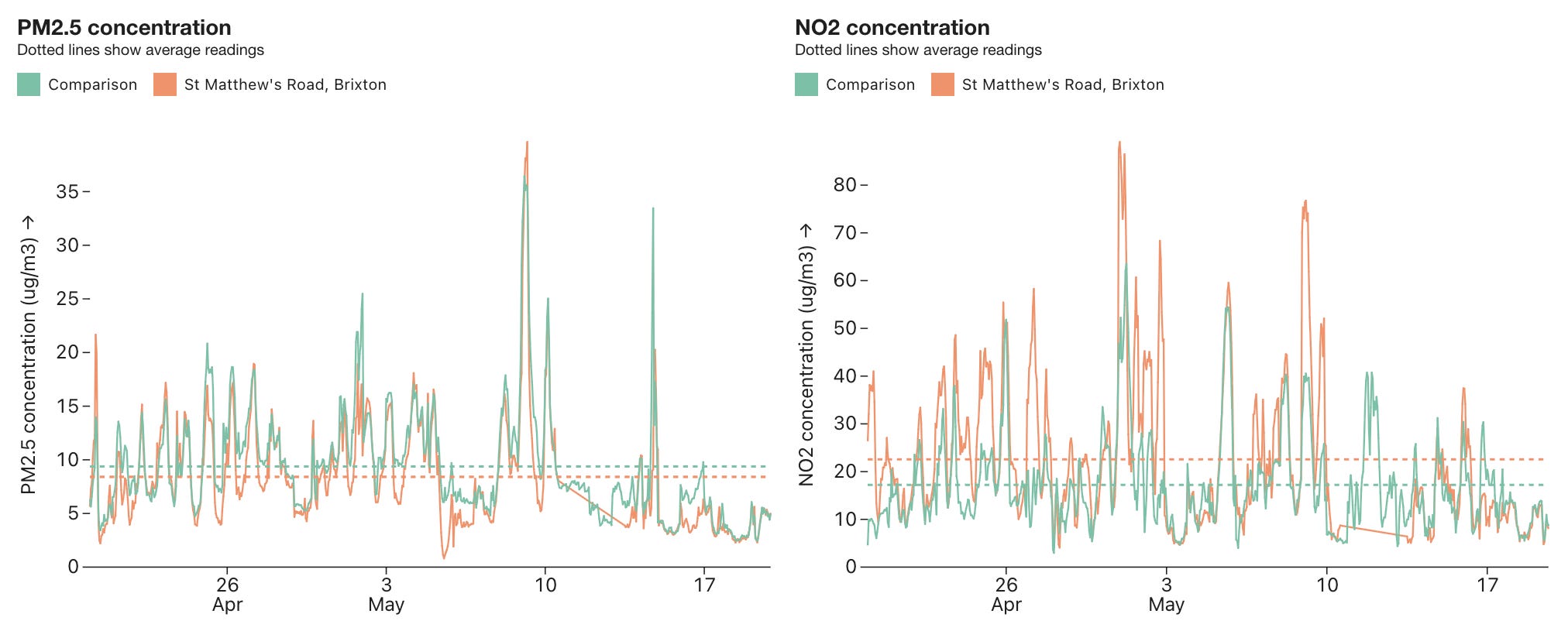
As reported last week, while establishing our new monitoring node, we spotted that there is a new node on the other side of central Brixton (ironically near to where we originally wanted to site ours but got stuck in planning permission). So now that our new monitor has been up for 10 days we thought we would take a look at both of them - International House is the green comparison line here. (The slightly downwards orange line just after 10 May is where our node was briefly offline during the changeover).
What have we spotted?
the peaks in particulate matter (which led to the concern about node malfunctioning) seem to exist at International House too - so it does seem something is happening across the locality and it’s not a measurement error
nitrogen dioxide varies quite a lot between the two - this is not surprising given the impact of traffic and that they are at quite different road locations
we are still seeing some huge spikes at both locations and for both pollutants, despite the more favourable weather recently.
Survey time!
For AirTrackers out there, please consider taking part in this survey. As part of a MSc research project, we are collaborating with University College London to understand individuals’ relationship with air quality information.
The research project will involve taking part in a short survey, asking about your experiences with using AirTrack. The study seeks to understand the barriers and facilitators to individuals engaging with air quality information, how apps like AirTrack can facilitate greater knowledge and positive behaviour change with air quality information.
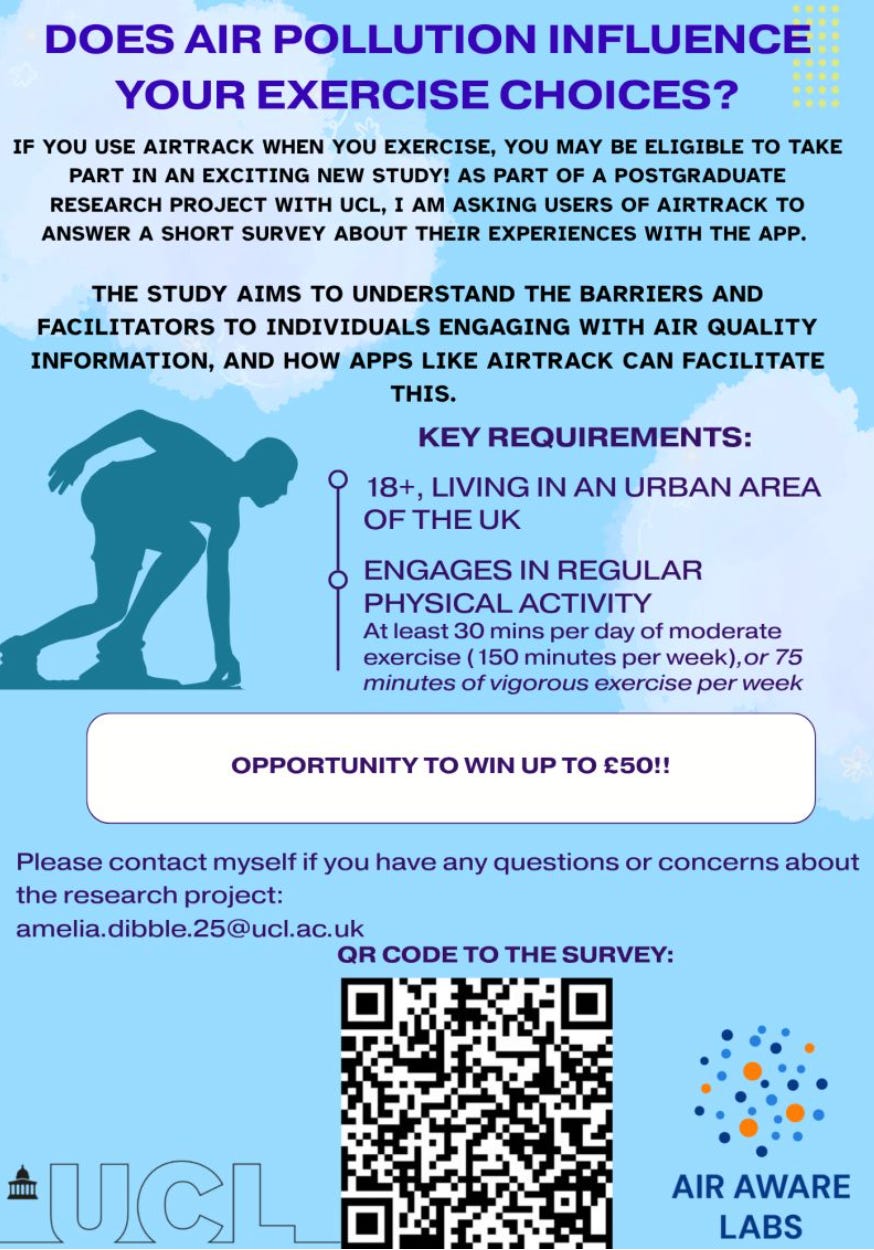
Participation in the study includes the opportunity to win up to £50. Link to survey!
And finally…
We know that plastic pollution and air pollution are deeply connected. Microplastics are now being found in our lungs, blood and even placentas, entering our bodies through the food we eat, the air we breathe and the products we use every day.
So we wanted to highlight this event from friends of this blog, Earth Set, in partnership with Blue Earth. Plastics Without Borders: Inside Us | Tuesday 2 June | 7–9.30pm | Mother, Shoreditch. Sign up here!