


Anyone watching the news coming out of government? Maybe the budget? Well this Monday, the government brought out a major update to air pollution policy, hidden on page 40 of the new Environmental Improvement Plan.
This commits the UK to reaching interim World Health Organisation guideline for fine particulate matter (PM2.5) by 2030, rather than 2040 as previously. This brings the UK in line with the EU, with the aim of reaching an average 10 micrograms per cubic metre. It doesn’t of course mean meeting the actual WHO guideline (5 micrograms) nor say anything new on nitrogen dioxide or other pollutants*. It does however include an updated 2030 target for exposure to PM2.5 - aiming to achieve 30% reduction compared to 2018, also by 2030 instead of 2040.
We hope the change is more than theoretical
There are a large number of actions to help achieve the new and existing goals. The main ones are summarised in the theory of change below (from this companion document about monitoring the plan). Yes, perhaps only Louise as an ex-civil servant will be impressed rather than baffled!
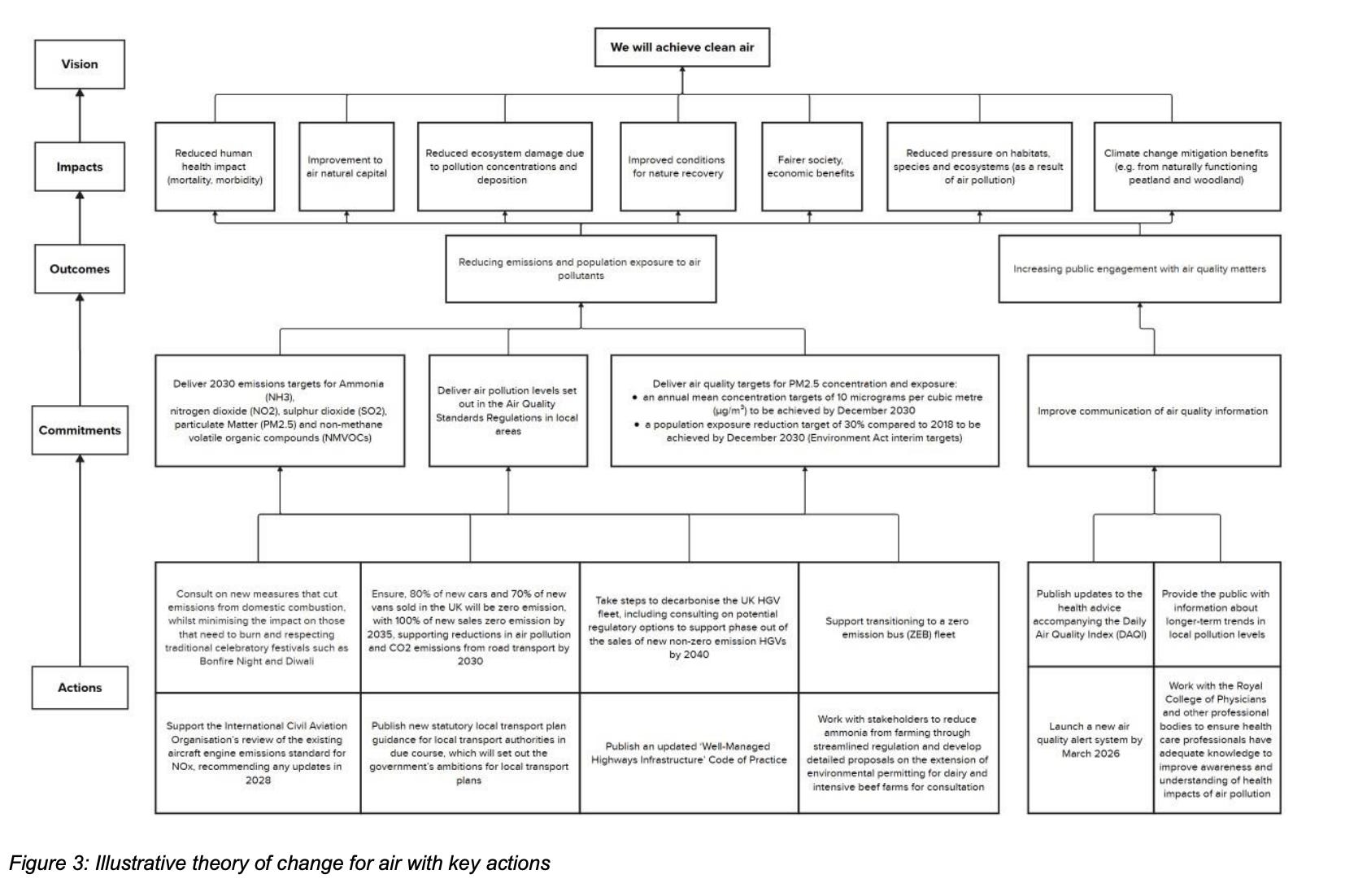
It’s hard to know which actions are truly new or significant of the total 35 listed. For instance, will the action about updating health advice alongside the air quality index actually result in information for citizens that’s more in line with the latest scientific and international policy evidence? Time will tell. It looks like there is an intention to formalise the legislation around e-scooters, but only if parliamentary time allows. The action on electric vehicles looks like a restatement of existing policy (and also gives the impression that EVs don’t pollute - which we know is not the case).
A slow burn
The stand out commitment seems to be a new consultation around reducing emissions from domestic burning. As we have covered, the Clean Air Night campaign is seeking to draw attention to the health harms caused by burning. The Guardian certainly thinks it’s a significant commitment.
Also, any civil servants will be looking closely at who is responsible for the actions - primarily DEFRA, but a fair few for DfT and UKHSA and a handful for MHCLG, DHSC and Active Travel England. (At this point we relax our usual approach of spelling out all acronyms!)
Empty glasses
And what’s missing? Well, lots. Friend of this blog, Peter Knapp, has set out his thoughts in Air Quality News here. Many areas could be more ambitious, but one aspect that is totally overlooked - contrary to many policy shifts we see elsewhere - is indoor air quality.
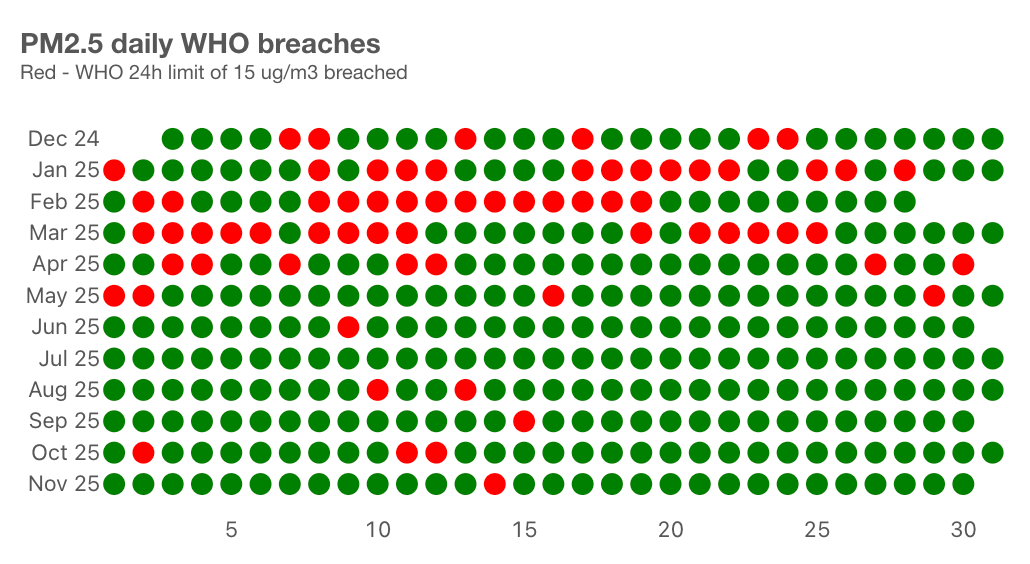
There have been complaints that the 10 microgram target has practically been met anyway, so the real WHO target of 5 micrograms would be the way to demonstrate real ambition. Certainly our Brixton monitoring node annual average is around 11. Annual averages of course hide huge variation. And at the same node, the WHO daily guidelines on PM2.5 have been breached around 70 times over the past year.
We never like to end on a downer and this week we have a very nice post script! Air Aware Labs has been nominated as finalist in five categories of the Tech Trailblazer award - AI, Big Data, Diversity, Sustainable Tech and (somewhat inappropriately for an air pollution company) Firestarter! The final awards include the results of the public vote, so please vote for us here! It’s open till next Friday.
*We don’t think these are new, but rather restatements of the aim to reduce NO2 by 73% between 2005 and 2030, and various other reductions as set out on page 41 of the Plan.