

School still suffering
Our pollution is well over budget

We’re starting year 3 of this blog raring to go with our local campaigning! We’ve submitted a deputation to speak at the upcoming Lambeth meeting on 4 March to try to get our local primary School Street back on track after it was indefinitely postponed in the Autumn due to budget cuts. We got 29 signatures from parents at the school - we reckon this represents about a quarter of the school population. And the Executive Head has written to local councillors to express the urgency. Lambeth Council initially declined the deputation request as they thought it didn’t relate to the budget, but have now accepted it does, so we are waiting to see if we get a slot next Wednesday.
School Streets have been shown to reduce nitrogen dioxide by up to 23% at drop off and pick up times. This same study showed strong (81%) support from parents, and a shift in travel patterns with 18% reporting driving less. This more recent, and more qualitative, report has some really interesting findings on how the streets are used by school communities, including a case study of nearby Bessemer Grange school. This Mums for Lungs overview is helpful, including the finding that school children are exposed to five times more air pollution on the school run than at any other time of the day. We made use of this Mums for Lungs flyer to raise awareness at the school gate while collecting signatures.
Barely any air
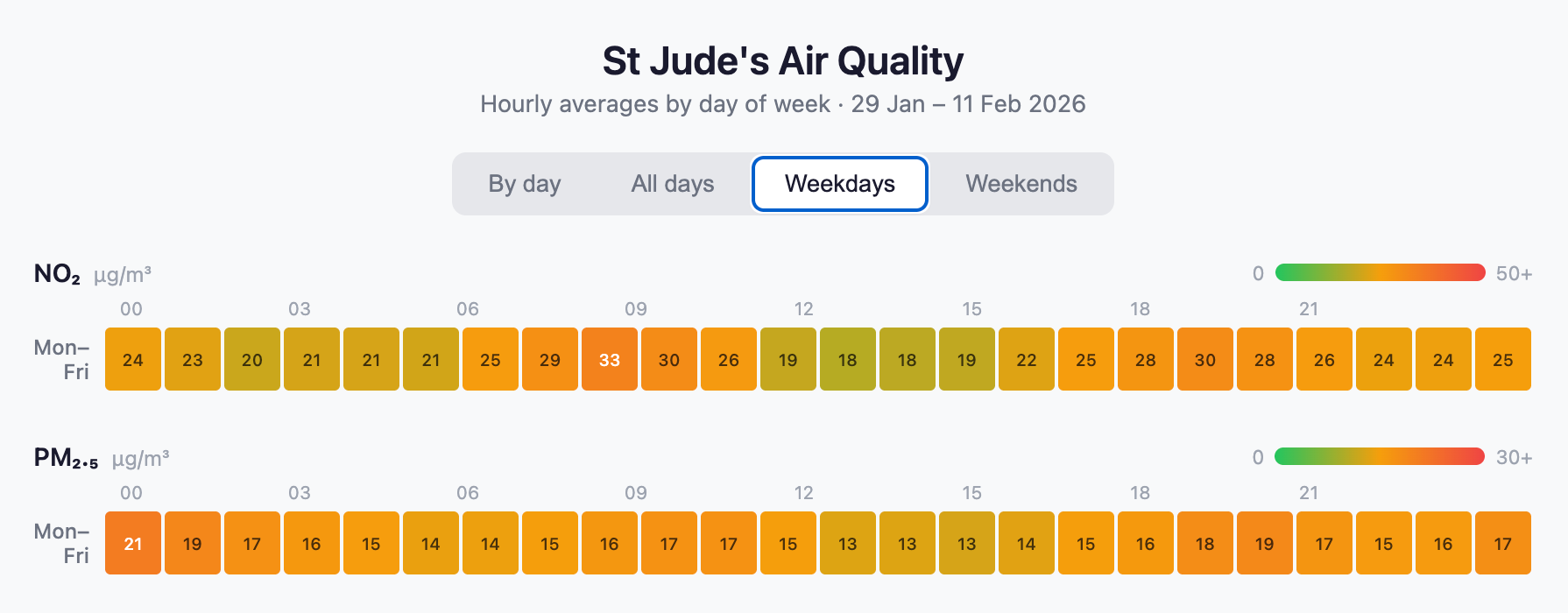
Luckily we don’t have to guess about the current air pollution conditions. We recently found that there is a monitor at the school, funded by the Council and run by a company called Airly, who were kind enough to give us a download of pollution data for two weeks in late January and early February. Here are our findings:
average fine particulate matter (PM2.5) was 12.7 micrograms per cubic metre (ug/m3); for comparison the World Health Organisation (WHO) recommended annual average is 5
there were at least four* days (all weekdays) where PM2.5 exceeded 15 ug/m3 over those 24 hours; WHO recommend no more than 3-4 days per year for this limit to be breached
average nitrogen dioxide (NO2) was 22.2 micrograms per cubic metre (ug/m3); for comparison the World Health Organisation (WHO) recommended annual average is 10
there were at least three* days (all weekdays) where NO2 exceeded 25 ug/m3 over those 24 hours; WHO recommend no more than 3-4 days per year for this limit to be breached
So over those two weeks, the average was significantly (more than double) higher than the annual recommended average. And the daily limits were breached up to the maximum recommended per year in just nine working days. *The data for 4 February was missed which was right between high pollution days on 3rd and 5th so most likely would add to these counts of days.
We’ve done one of our heat maps to show how the levels vary through the day. For both NO2 and PM2.5, we can see morning spikes either side of 9am. The afternoon rush hour is more drawn out, as some children leave at 3.30 while others stay up till 6pm. It looks like the levels keep rising through this period and take a while to disperse into the evening.
Beyond pollution, we see almost daily safety issues affecting the children, to the extent that the school has stopped dismissing children from the main gate from after-school clubs due to the danger.
Parish notices
The deadline for evidence to the Parliamentary Inquiry on air pollution is 3 March and we have drafted our submission.
We have also completed the feedback for the government consultation on solid fuel burning. It’s quite in depth but Mums for Lungs have done this helpful guide. Deadline for this one is 19 March, if you feel so inclined.
You can also take part in Mums for Lungs 7 day air pollution challenge from this Saturday! This includes:
💚 Flyers and posters,
💚 A clean air window sticker,
💚 Information and how-tos on the daily challenges.
💚 A link to their time-limited Clean Air Crowd WhatsApp group, so they can stay in touch during the week and share daily reminders for the activities.
Can we add our own challenge for you?.. Sending us luck for our pitch to Lambeth Council!
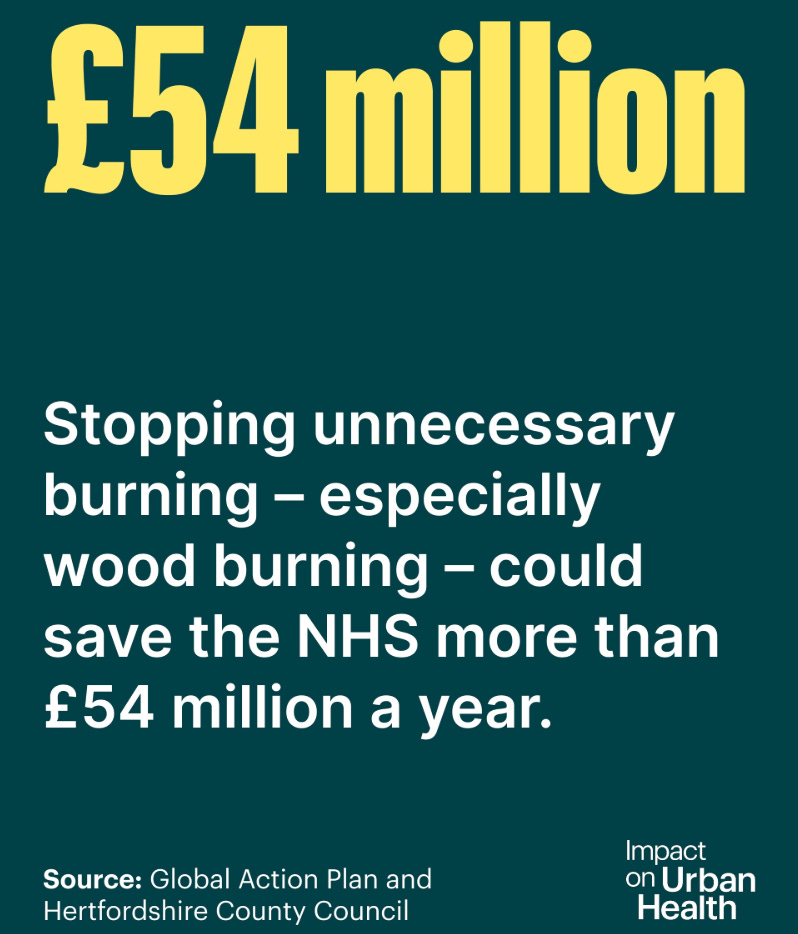
Secondly, Open fires in domestic properties - 44,000 people have accidents from falling down staircases in the UK, 1,000 die as a result every year. (NHS costs maybe £55m) Should we ban staircases in all homes and only build bungalows? We can design and build safer staircases. Will we stop all accidents or deaths? Probably not. Nor should we kid ourselves that we can.
https://www.rospa.com/safety-campaigns/safer-stairs#:~:text=Falls%20on%20stairs%20and%20steps,needlessly%20dying%20and%20getting%20hurt.
Stupid Targets are actually harming London. - The Mayor's Transport Strategy sets out the goal that, by 2041, all deaths and serious injuries will be eliminated from London's transport network.
I am not going to waste my time by listing all the accidents caused by buses, trams, cyclists or e-scooters, or the alarming number of accidents on 20 mph roads, but all we do is shift the cause, not eliminate it.
Why can't we focus on getting rid of diesel buses and scrap them so they are not used elsewhere?
If Regent Road is a school street, where do the parents drive and park? Sudbourne School is surrounded by school streets, Lambert Road, Mandrell Road and Strathleven Road. It hasn't stopped parents from driving; they just park on the roads outside the school streets in areas where they are not legally permitted to park. My point is, what are the unintended consequences? School streets do not stop parents from driving; they just displace the problem. I do agree that they make accessing the school safer. However, the school's streets around Henry Cavendish Primary School are poorly signposted, resulting in fines for residents and road traffic displaced to roads not designed for the high volumes of traffic.