

CAN we fix it?
The Royal Colleges say we can

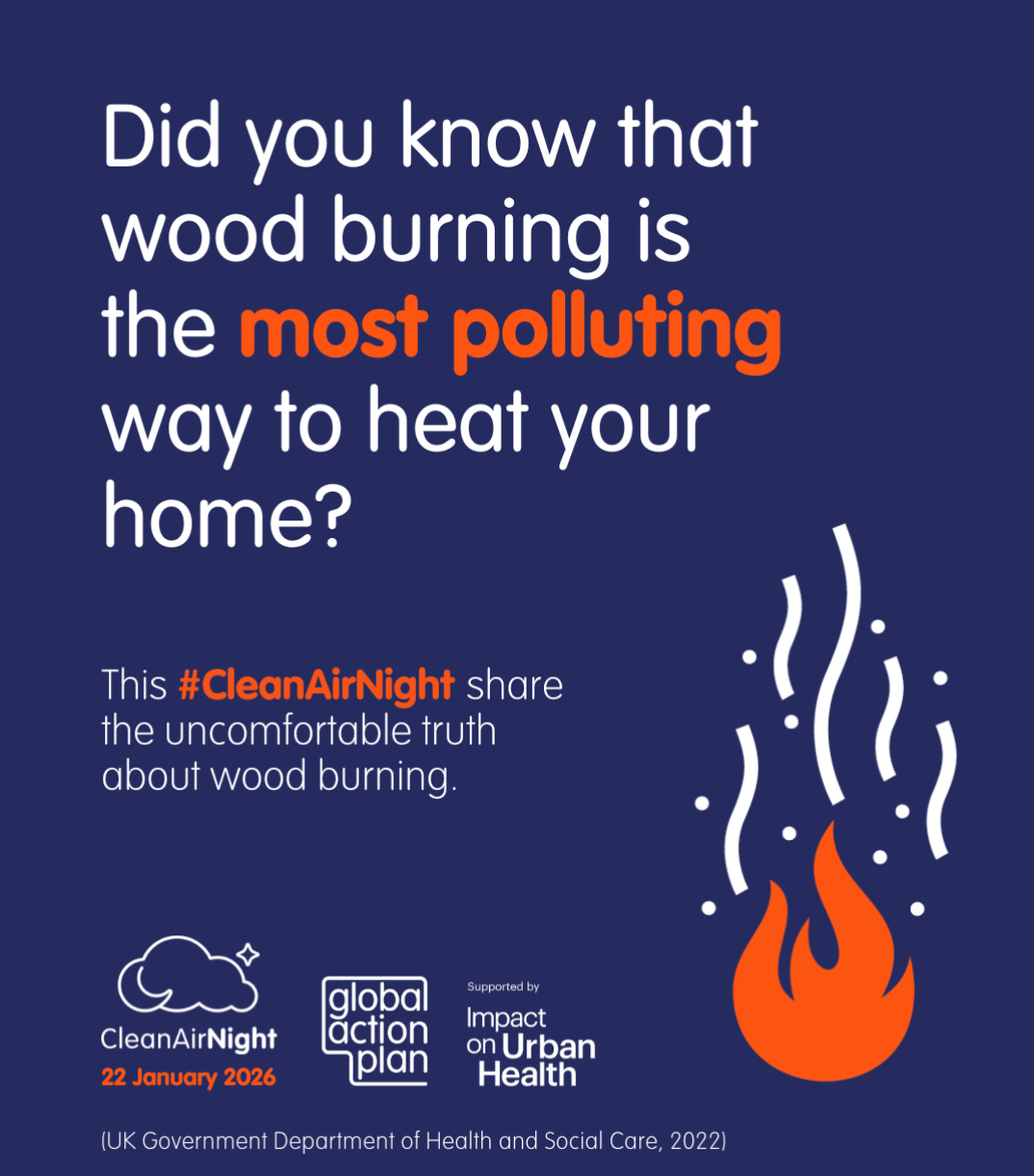
Clean Air Night is a week away and we’re doing our bit to raise awareness of domestic woodburning*. As the campaign says: we all want to stay warm this winter, but cosiness shouldn’t cost our health.
Breathing in air pollution from wood burning increases your risk of heart and lung disease, asthma, diabetes and dementia. Even homes with newer “Ecodesign” wood burners are three times more polluted than those without. There is a wealth of further information on the Clean Air Hub.
Readers of this blog will know that we like to supplement any national or international campaigns and data with local data from our Brixton monitoring node, supplied by Breathe London. However, there have been some technical problems across many of these nodes and our data doesn’t look very up-to-date. What we do know is that fine particulate matter was particularly high during winter months in 2025.
New research shows that if we stopped burning wood where another heat source is available, we could avoid more than 1500 premature deaths in the UK each year, save the NHS over £54 million in healthcare costs (which is the equivalent of 1.5 million GP appointments) and prevent £164 million wider productivity costs to the UK economy annually.
Sparking controversy
We were a bit surprised to find some fellow air pollution warriors comment that campaigning on woodburning is a step too far, and may put the movement in jeopardy. Perhaps. We admit that we didn’t follow the fad of woodburners more due to lack of the right infrastructure in our house than about understanding of the health impacts, when we took that decision years ago. If we had gone for it, no doubt the current campaign would be rather annoying. But like any polluting asset, there is always a choice about how much, if at all, to use it.
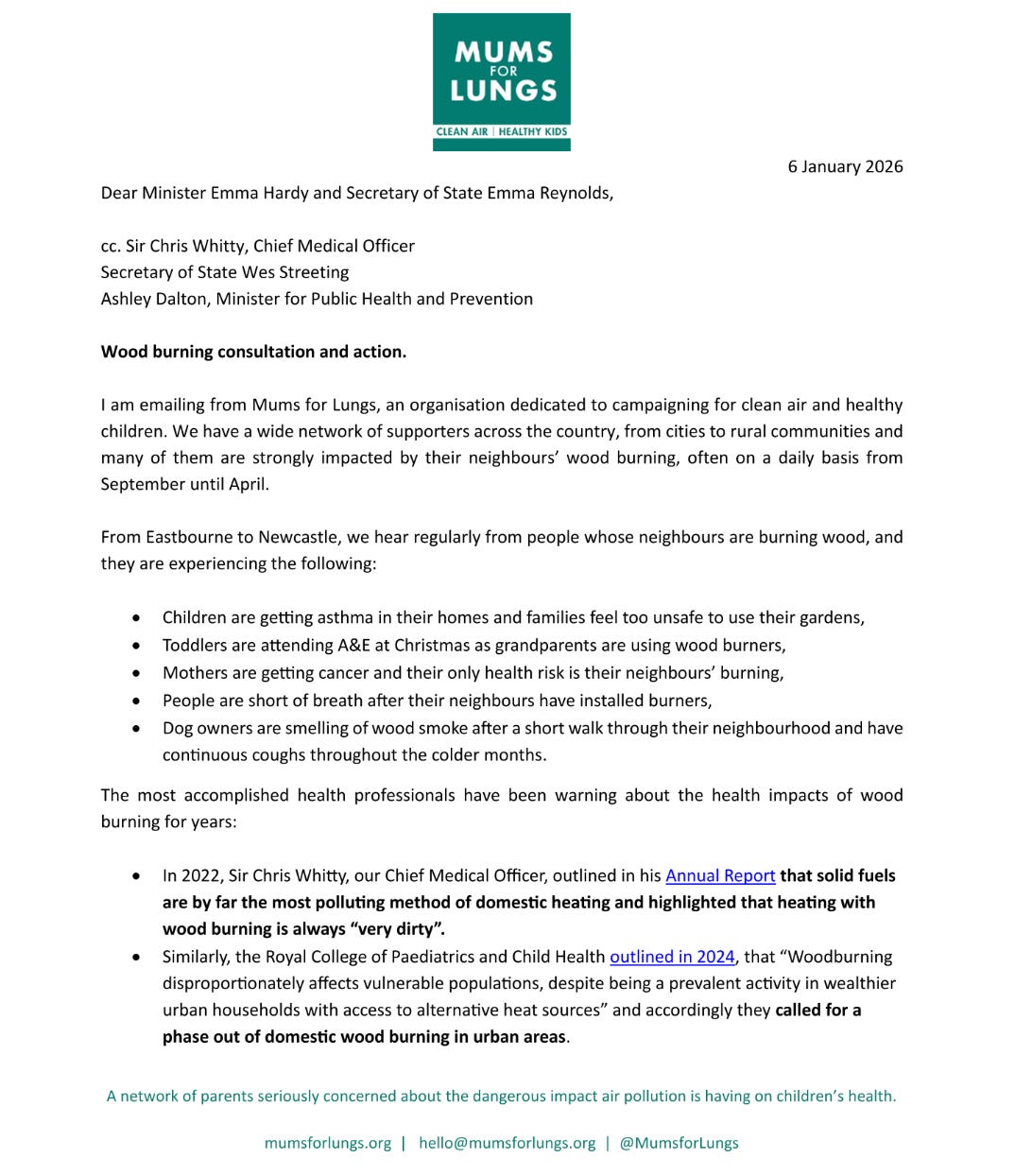
We’ve reported before about the lack of enforcement of current regulations on smoke control zones in cities. Mums for Lungs has written to the government to push for more ambition on the proposed consultation on woodburning. They point to work from the Chief Medical Officer, the Royal College of Paediatrics and Child Health and the Royal College of Physicians - as if any more expert opinion is needed! We look forward to a response soonest…
*You’ll see a little logo to demonstrate our supporter status on this page!
Thank you, Will AAL scientist, for your interesting insights. I agree, pollution will harm. But given the choice of sitting in a home with an open fire, or a home with a log burner, or sitting behind a London TfL diesel bus sat in a queue of traffic with its engine pumping out into the air vent of my little EV car, (as happened yesterday), I know which I would prefer!
Which will have the biggest impact? Campaigning for stamping out a few open fires, or fixing the transport system in London? I spent the Christmas break in Dijon and Reims. Both cities have electric trams, electric buses and a joined-up approach to transport! London's approach to transport is a flawed policy that is unlikely to be fixed anytime soon.
Brixton Hill is often a queue of buses pumping out some of the worst toxic crap that man has made.
"Sir Sadiq Khan’s ambition of electrifying the entire London bus fleet by 2030 will be 'next to impossible to achieve', according to a bus company executive."
https://www.standard.co.uk/news/transport/electric-buses-sadiq-khan-warning-diesel-2030-london-b1263635.html
And Will (AAL), you might need to help, but I am curious if London would benefit from converting the bus fleet to HVO100 whilst if finds a few more capacity in the grid?
I live in a Victorian house in Brixton with one remaining open fireplace. Our primary heating is provided by an efficient gas boiler. We have triple glazing to the rooflights and home office windows, and double glazing elsewhere. The loft insulation exceeds what was required under the Approved Documents at the time of installation. As a result of these measures, our gas usage has reduced by around 50%, from 2106m3 to 983m3.
We also have PV panels, a smart hot water cylinder, and smart lighting, all aimed at reducing our electricity consumption, which has reduced from 7332 kWh to 5121 kWh (which now also includes charging our EV car).
I use an internal air-quality sensor, which normally sits in our home office. While writing this, the readings are: CO₂ at 677 ppm, PM2.5 at 15 µg/m³, and a temperature of 22°C. Recently, I moved the sensor into the living room — the only room with an open fire. What surprised me was how little the readings changed when the open fire was lit. CO₂ increased modestly, fluctuating between around 743 and 880 ppm, and PM levels barely moved at all.
Notably, this living room is also the least upgraded part of the house. The ground floor is poorly insulated, has open floorboards, badly insulated garden doors, and a cold kitchen beyond. In other words, it is far from airtight or thermally efficient.
This leads me to a genuine question rather than a statement: why are we seeing children taken to the hospital due to exposure to log burners?
I suspect that the issue is less about the existence of log burners themselves and more about how they are installed, ventilated, and used.
In my part of Brixton there are around 1,000 homes. I know of only a handful where logs are stacked outside front doors, and even fewer where you can regularly smell wood smoke. By contrast, I frequently find myself sitting behind long queues of diesel-powered TfL buses on Brixton Hill, operating virtually 24 hours a day.
So where should our focus really be? On trying to eliminate the handful of domestic log fires, or on tackling the hundreds of buses producing emissions continuously across London?